Shikoku, Japan · 1,200 years of walking
Walk TogetherHow One Becomes Immortal
Because of delusion, the three worlds are a prison. Because of waking, the ten directions are empty. There was never an east or a west. Where, then, is north or south? — written on the hat, so that it can be read by whoever finds you face down.
There is an island where you begin by dressing for your own funeral, and then walk fourteen hundred kilometres in the clothes they bury you in. Nobody there thinks this is strange. A Dutch woman who has spent twenty years stopping paintings from ageing goes to find out what the island knows.
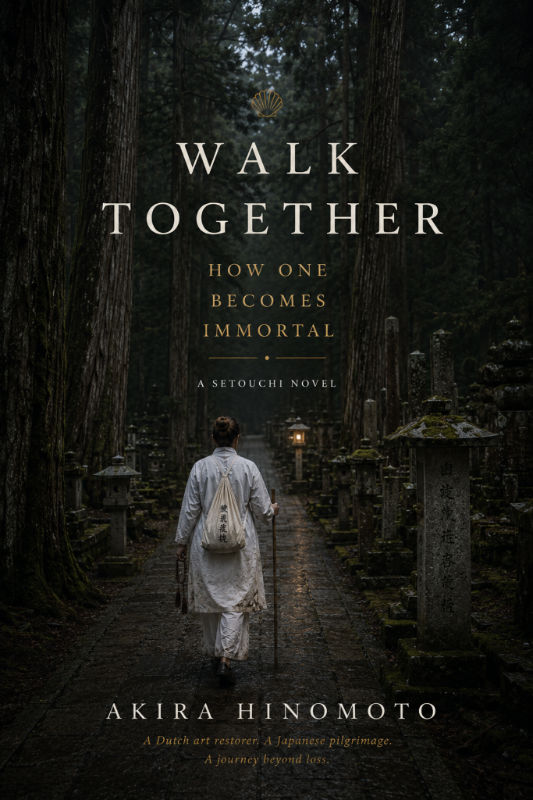
Akira Hinomoto
The story
She has spent twenty years stopping things from ageing. None of it works on a person.
Sterre isolates pigments. She seals canvases behind climate-controlled glass. She holds four-hundred-year-old paint at the exact moment it was made, and she is very good at it.
Her husband has been dead a year.
At three in the morning, drunk in a silent kitchen in Amsterdam, she opens a language model — because she does not want counselling, and she does not want an algorithm offering her the five stages of grief — and types the only question she has left.
Has anyone ever actually beaten death.
It answers with a monk who sat down in a cave in 835 and, as far as an entire island is concerned, never stopped breathing. And with four words that pilgrims still wear on their backs: Dōgyō Ninin.
Three weeks later she lands in Tokushima with a pack and no plan, leaving behind a fourteen-year-old daughter who has stopped going to school, and a mother who tells her she is running away exactly like her father did.
Fourteen hundred kilometres. Eighty-eight temples.
A second walker who is supposed to be there the whole way.
同行二人
Dōgyō ninin · two people, walking
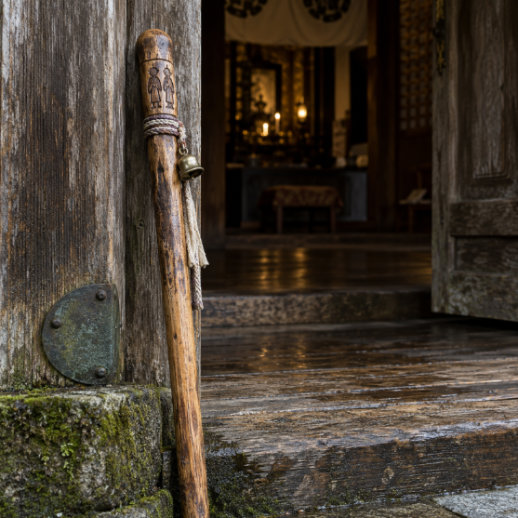
What the island believes
You are never walking this road alone, and the second walker is dead.
Twelve hundred years ago a monk named Kūkai walked a circle around the island of Shikoku. In 835 he sat down in a cave on Mount Kōya and stopped breathing. Japan has never accepted that he died. Twice a day, priests still carry hot meals to the closed door of his tomb. A ceremonial robe is taken in and replaced. Nobody has looked inside since 1080.
So the pilgrim wears white, which in Japan is the colour of the dead, and carries a cedar staff that is not a walking stick but Kūkai's body, washed each night before the walker washes, put to bed indoors while the walker sleeps. Two people. One of them is not there. Ask anyone on the trail and they will tell you this without a flicker of embarrassment.
This is not folklore that survives in a museum case. It is going on this morning, in the rain, on a road you can be standing on the day after tomorrow.
The circuit · eighty-eight temples, four provinces
The old names for the four stages are not tourism. They are a diagnosis.
Shikoku's four prefectures keep their older provincial names on the pilgrimage, and each is a dōjō — a training hall. Walked in order, they are supposed to take you apart and then put you back differently.
Temples 1–23 · Tokushima
発心
Awakening
Where you buy the white robe and the staff, and discover in the first eleven kilometres that you have brought the wrong shoes and the wrong reasons.
Awa · 190 km
Temples 24–39 · Kōchi
修行
Discipline
Eighty kilometres of Pacific coast between one temple and the next. Two capes. Wind that comes in sideways. This is the stretch people quit on, and the stretch people go back for.
Tosa · 400 km
Temples 40–65 · Ehime
菩提
Enlightenment
Mountain mist, the oldest hot spring in Japan, and the first days the walking stops hurting enough that you notice where you are.
Iyo · 470 km
Temples 66–88 · Kagawa
涅槃
Nirvana
Temples close together, the circle almost shut, and the strange dread of finishing. Then the ferry, and the climb to the cave where the second walker is waiting.
Sanuki · 340 km
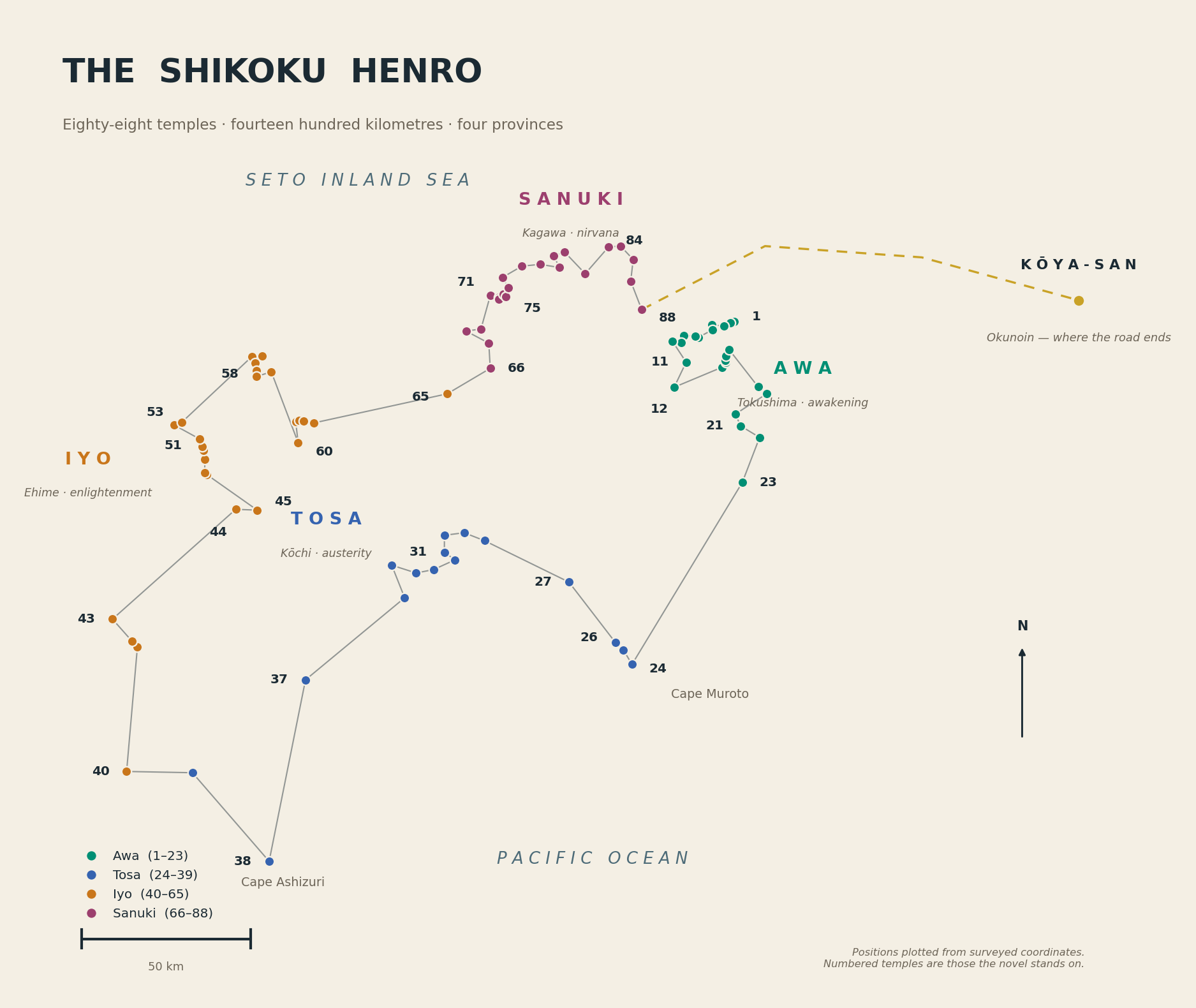
Plotted, not drawn
Every one of the eighty‑eight, where it actually is.
Most maps of the henro are decorative and quietly wrong — temples in the wrong bay, numbers out of order. This one is drawn from surveyed coordinates for all eighty-eight, in walking order, with the thread that carries on to Kōya-san after the circle closes.
Osamefuda · the name slips
You leave your name at every temple. The colour says how many circles you have walked.
You hand one to anyone who shows you a kindness, too. Receiving a gold slip from a stranger on a mountain path is the sort of thing people remember for the rest of their lives. Brocade slips are cut up and carried as charms.
1–4
White
5–7
Green
8–24
Red
25–49
Silver
50–99
Gold
100+
Brocade
If you want to go
You do not have to be devout, Japanese, or fit. You do have to start.
The henro has carried foreigners for decades and the island is unbothered by you. English signage is patchy and the hospitality is not — this is the one road in Japan where strangers hand food to walkers and will not accept thanks, let alone money.
- On foot
- 40–60 days for the full circle, walking 25–30 km a day. Roughly 1,400 km.
- In pieces
- Kugiri-uchi — walk one province this year, the next one next year. Completely normal. Most Japanese walkers do it this way.
- Without walking
- Bus pilgrimages close the circle in 10–12 days; by car, about 10. Nobody on the road treats this as cheating.
- When
- March–May and October–November. Avoid the June rains and the August heat, which is genuinely dangerous on the Kōchi coast.
- Settai
- Gifts to pilgrims — a tangerine, a coffee, a bed. Refusing is the rude thing; you are meant to accept, and hand back a name slip.
- What it costs
- Family inns and pilgrim lodges, roughly ¥6,000–9,000 a night with two meals. Free shelters exist and are used.
Start at Temple 1, Ryōzen-ji, eleven minutes' walk from Bandō station and about ninety minutes from Kansai airport by bus and train. The shop inside the gate sells the whole outfit. People land in the morning and are walking by lunch.
From the opening pages
The Formula
“I'm just saying. If we don't have the shallots, we use the red onions. It is an easy fix.”
The cobblestones of the Keizersgracht are slick black mirrors. The rain does not fall so much as hang in the air, a fine freezing Dutch mist that beads on my eyelashes and works its way down into the wool of my coat.
“A recipe is a formula, Bram.” I duck my chin into my collar against the damp. “You change an ingredient, you get a different thing. The acidity alone is completely off.”
He laughs, that soft booming laugh that cuts clean through the cold coming off the canal. “It's risotto, Sterretje. It's not a Rembrandt. I promise you, one slightly louder onion is not going to bring down our Tuesday night.”
“You spend your whole day at the museum trying to stop time,” he says, bumping his shoulder against mine. “You isolate pigments and put canvases behind climate-controlled glass so they never age a single day. Food is different. It is meant to be consumed. But the beautiful part is that it survives anyway, even after the plates are washed…”
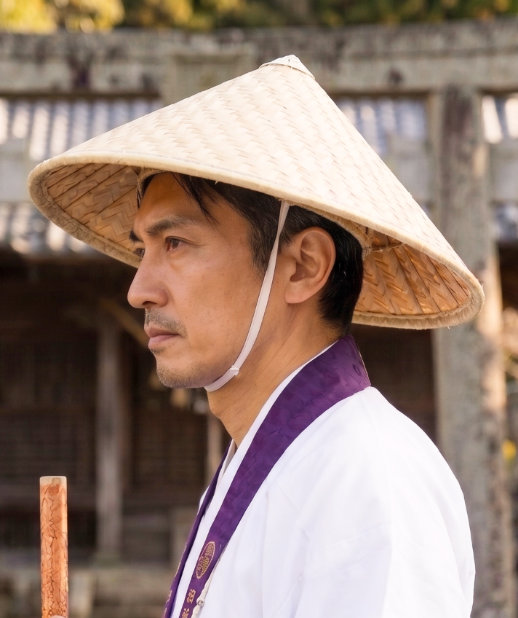
Kagawa, Shikoku
About the author
He has lived beside this road for forty years.
Akira Hinomoto lives in Kagawa, near the end of the circuit — where the temples sit close together and walkers come through with the circle almost shut.
He spent twenty-two years taking Japanese machinery into more than seventy countries, and wrote his first novel, Beyond The Water, out of that work.
He wrote this one for a different reason. The henro has been walked for twelve hundred years. Nobody can promise it will be walked for another hundred. The houses are emptying, the villages are thinning, the crafts are going quiet — and a pilgrimage is not a monument. It survives only as long as people keep walking it.
This book is an argument for walking it.
彼岸
Higan · the far shore
Why this week
The far shore, and the seven days it comes closest.
彼岸 is the Buddhist name for the other bank — where the dead are, and where we are not. This shore, 此岸, is the one with the grief standing on it.
Twice a year, at the equinoxes, Japan keeps a seven-day observance named after it. The sun rises due east and sets due west. Day and night are the same length. Nothing is tilted. The old teaching is that this is when the distance between the two shores is at its shortest, and there is even a practice for it — sitting to watch the sun go down due west, and using it to see through.
For those seven days the country goes to visit its dead. Stones are washed, water is poured, ohagi is left out. The equinox itself is a national holiday, and its stated purpose in law is to honour ancestors and remember the people who have died.
This book comes out on the last day of it.
I did not choose the week because I believe the boundary thins. I chose it because this is a novel about a woman who goes to find out whether it does — and because the road she walks makes the same claim every day of the year, not only for seven days in September.
23 September 2026
Eighty-eight temples. Fourteen hundred kilometres. One question: whether anyone has ever actually beaten it.
Out on the autumn equinox — the day the walkers say the road between the two worlds is shortest.
Not sure yet? Start reading.
The prologue and first chapter, as a PDF, straight away.
Then one email on 23 September when the book goes live. Nothing else.